

You Have an Agentic Mandate. Now What?
AI leaders are told to make the organisation agentic. Most get pilots, not an operating model. Start with an experience layer from your enterprise systems, then design the agent architecture that uses it.
If you are the person who just inherited an agentic mandate, you already know the awkward part. The board wants transformation. The vendors want a pilot. Your teams want clarity. What you rarely get is a clear account of how an organisation actually becomes agentic.
So the default path looks familiar. Stand up a few agents. Point them at a knowledge base. Wire a CRM tool. Demo something impressive. Then watch the same problems return on week three: cold starts, conflicting answers, forgotten corrections, and a growing pile of "AI projects" that never become an operating system.
What follows is how we think about that work with teams who want agents that improve at real work, not just answer questions about documents. It comes in two layers, because that is where most programmes get stuck:
- Prepare the organisation's systems for an experience layer that can learn the business and keep updating itself.
- Design the agentic architecture that uses that experience across existing and new workflows.
Skip the first and every agent starts empty, no matter how clever the second looks. Build only the first and you have a library with no operators.
The Mandate Without An Operating Model
Most AI leaders are not short on tools. They are short on an operating model.
If you have already built with LangGraph, the OpenAI Agents SDK, CrewAI, or an IDE-native agent, you know the pattern: the model is capable, the demo is sharp, and the organisation still has to re-teach the same lessons every week. The missing piece is not another orchestration framework. It is a durable way for agents to absorb how this business works, and a clear design for which agents own which outcomes.
That is why "buy more agents" fails as a transformation strategy. Agents without experience repeat your org chart's tribal knowledge forever. Experience without architecture never reaches the workflows that matter.
Part 1: Seed The Experience Layer First
Before you redesign every workflow, ask a more basic question: when an agent starts work on Monday morning, what does it already know about your business?
In a healthy organisation, the answer should not be "whatever fit in the prompt." It should be a governed body of Lessons drawn from the systems you already run, then kept honest by every finished run that follows.
Your Systems Already Hold The Starting Material
Enterprises are not short on knowledge. They are short on a way to turn that knowledge into behaviour.
Look across a normal stack and the sources are obvious:
- CRM systems such as Salesforce, Microsoft Dynamics 365, or HubSpot hold accounts, opportunities, cases, call notes, win/loss reasons, and the playbooks sales and success teams actually use.
- ERP platforms such as SAP, Oracle, NetSuite, or Dynamics Finance hold order-to-cash, procure-to-pay, inventory, credit terms, and the exceptions finance teams resolve by hand.
- Knowledge bases such as Confluence, SharePoint, or Notion hold policies, runbooks, product rules, and the "how we do it here" pages nobody puts in a prompt.
- Service and ITSM systems such as ServiceNow or Jira hold incidents, changes, SLAs, and the resolution patterns that keep operations upright.
- Data platforms such as Snowflake, Databricks, or BigQuery hold warehouse facts, cohort definitions, and the metrics teams already treat as authoritative.
- Internal services hold the APIs, tickets, chat exports, evaluation notes, and expert decisions that never made it into a tidy wiki page.
Those systems are not an experience layer. They are raw material. A CRM note is not a lesson. An ERP exception log is not a reusable rule. A Confluence page is not judgment.
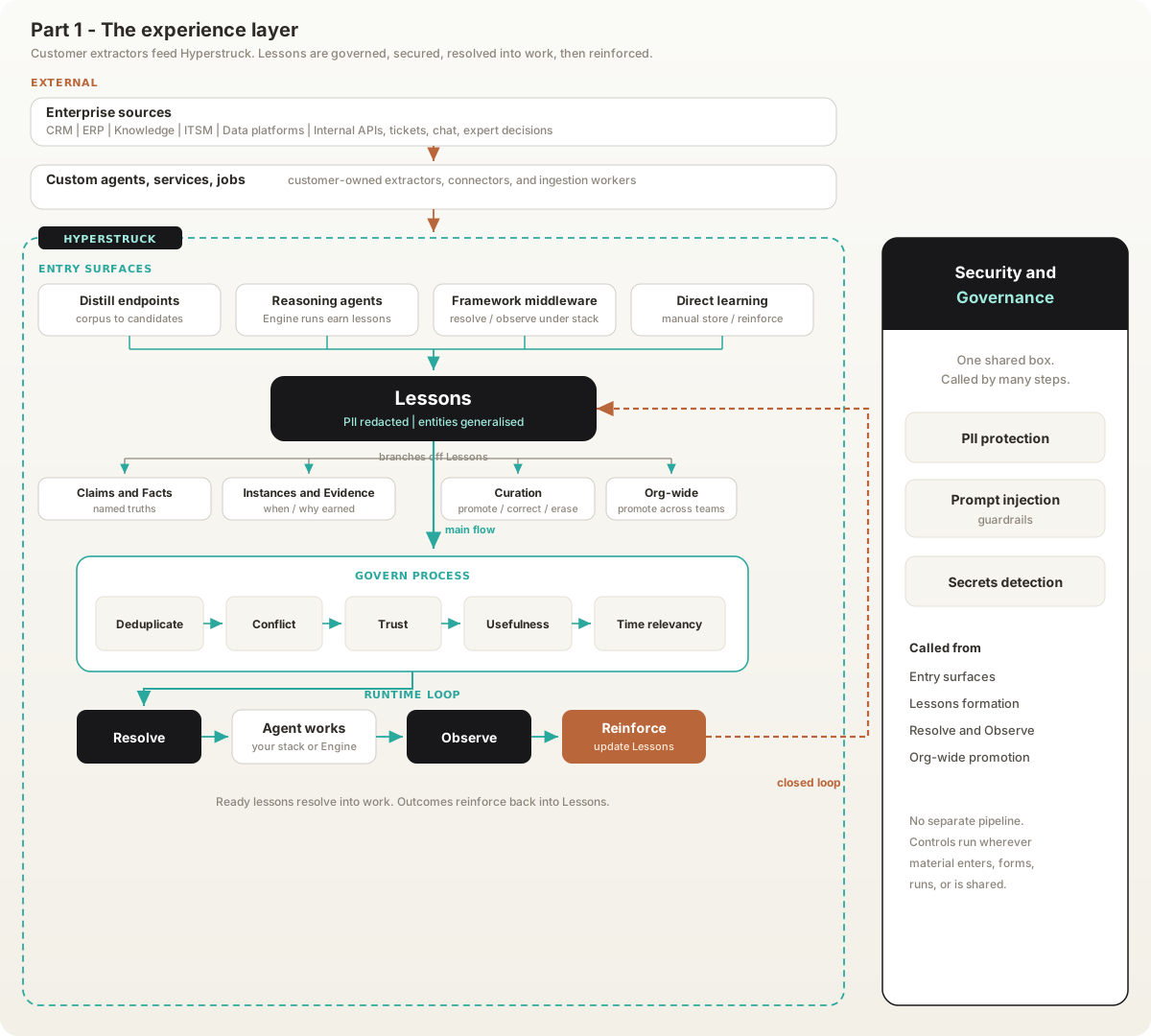
So the first move is still yours: custom agents, services, and jobs extract from those sources. Ingestion workers, connectors, ETL jobs. When the source landscape is messy, our Forward Deployed Engineers often help stand those connectors up alongside your team. That layer stays customer-owned. Hyperstruck does not replace your systems of record. It receives what your extractors send.
Four Ways Lessons Enter Hyperstruck
The cold-start mistake is RAG-as-transformation: dump documents into a retriever and hope relevance equals expertise. That gets you passages. It does not get you experience.
What you want instead is a set of entry surfaces that turn source material and finished work into candidate Lessons. In Hyperstruck those surfaces are separate on purpose:
- Distill endpoints, when corpus content such as policies, playbooks, or case notes should become candidate lessons.
- Reasoning agents on Hyperstruck Engine, when complex runs earn lessons while they work.
- Framework middleware, when agents you already run in LangGraph, an SDK, or an MCP host call
resolvebefore work andobserveafter it. - Direct learning usage, when an expert already knows the rule and stores or reinforces it through the API.
Different paths, same destination. Candidate lessons land in one place.
Lessons Are The Unit. Everything Else Supports Them.
A Lesson is the centre of the experience layer: a reusable rule that changes behaviour. Before it is stored, PII is redacted and entities are generalised, so a useful pattern can travel without carrying a customer name or a private identifier with it.
Around that centre sit four branches, not a second filing cabinet:
- Claims and facts: the named truths that support a lesson ("this customer is on net-30", "the billing API returns cents").
- Instances and evidence: when and why the lesson was earned, so trust is not vibes.
- Curation: promote, correct, or erase when people need a hand on the record.
- Org-wide promotion: share a proven lesson across agents and teams once it is safe and general enough.
Then every new or updated lesson goes through a govern process in order: deduplication, conflict detection, trust scoring, usefulness scoring, time relevancy. Near-duplicates strengthen one entry. Contradictions get reconciled instead of sitting side by side. A lesson that once helped can lose standing when it stops helping or stops being current.
Security and governance is not a fifth step at the end. It is one shared box that separate parts of the workflow call into: PII protection, prompt-injection guardrails, and secrets detection. Entry surfaces call it when material arrives. Lessons formation calls it during redaction and generalisation. Resolve and observe call it mid-loop. Org-wide promotion calls it before a lesson is shared.
The Closed Loop Is The Point
Seeding is only valuable if it does not freeze.
Once a lesson is ready, the runtime loop is simple and continuous: resolve fits ready lessons to the goal, the agent works on your stack or on the Engine, observe submits the finished run, and reinforce updates Lessons. New source material keeps arriving through distill and direct learning. Finished runs keep arriving through middleware and Engine reasoning. Both feed the same centre.
That is the difference between a knowledge project and an experience system. Knowledge projects are launched. Experience systems keep score.
When this layer is in place, day one stops being blank. Agents start with a business-aware baseline instead of a cold prompt, then get sharper from real work. The cold-start tax drops. The re-teaching loop shortens. Org-wide learning becomes possible without copying markdown files between teams by hand.
Part 2: Design The Agentic Architecture On Top
Once experience has somewhere to live, the second question becomes practical: which agents own which work, what triggers them, and where Hyperstruck sits in that path.
This is where many programmes overcorrect. They either try to rip out every existing workflow and rebuild it as a greenfield agent platform, or they bolt a chatbot onto the side and call the organisation "agentic." Neither is architecture.
Start From Ownership, Not Models
Good agent design begins with workflow ownership, not model shopping.
For each candidate workflow, name five things:
- The business outcome. Close the invoice. Triage the ticket. Approve the change. Prepare the onboarding pack.
- The agent that owns it. One clear owner beats a swarm of helpers with overlapping prompts.
- The tools and systems it may touch. CRM write access is a different risk profile from read-only warehouse lookup.
- The lessons it should take from those systems. Which policies, exceptions, playbooks, and prior outcomes should shape this agent's judgment, not just which APIs it can call.
- The human gate. Which steps need approval, exception handling, or a person in the loop before the work becomes real.
If you cannot name those, you do not have an agent design yet. You have a demo script. And the people closest to the workflow are usually the ones who can name the lessons: the collections lead, the triage manager, the underwriter, not only the platform team.
Illustrative Workflow Shapes
There is no single catalogue of agentic workflows. This article walks two common shapes because they make ownership and Hyperstruck's place in the stack concrete. Use them as examples to pressure-test your own designs, not as a claim that every programme fits one of two boxes.
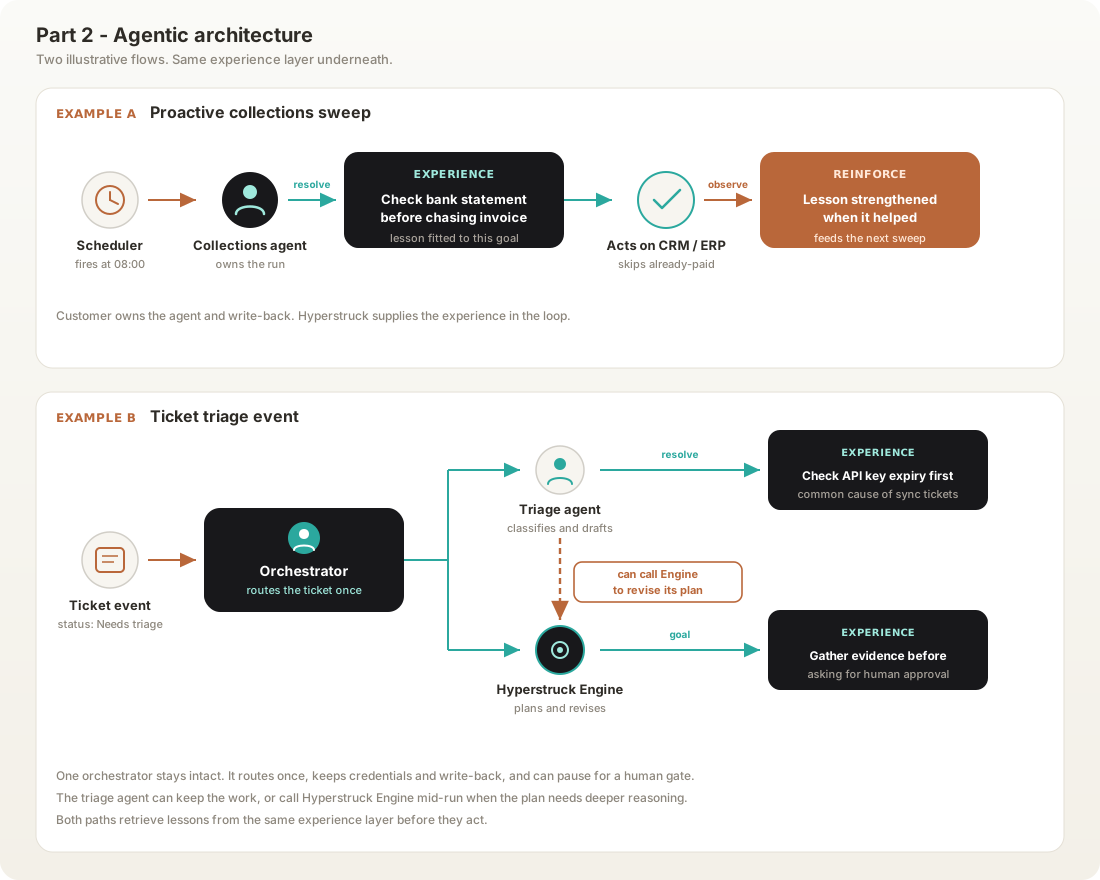
Example: Proactive / scheduled work.
A scheduler or queue fires on a cadence. Collections sweeps. Renewal checks. Compliance digests. The customer agent or orchestrator owns work selection, tool calls, and write-back. It calls Hyperstruck to resolve experience before the run and observe after it. If the goal is hard enough to need planning and recovery, that same orchestrator can optionally dispatch the goal to Hyperstruck Engine instead of keeping the reasoning in-house.
Example: Event / triage work.
A system of record changes state. A ticket moves to "Needs triage." A CRM opportunity hits a stage. An incident opens in ServiceNow. That event hits a customer orchestrator, which still owns routing, retries, SLAs, and which path runs next. From there the orchestrator stays one unit. It can hand the ticket to a specialist agent that keeps the work, calling resolve / observe under the experience layer and writing back to the ticket or CRM. That specialist can also call Hyperstruck Engine mid-run when the plan needs deeper reasoning or revision. Or the orchestrator can submit the goal to the Engine directly. Either way, the customer side still owns the trigger, credentials, final write-back, and often the human-approval UX. The Engine can pause at human-in-the-loop gates and return a result the orchestrator applies.
The design choice is ownership, not branding. Same experience layer under the paths you assemble.
What The Customer Owns Vs What Hyperstruck Owns
Keep the boundary boring and explicit.
Customer / external: systems of record and event producers, schedulers and queues, orchestrators and routing, specialist agents when you want to keep them, tool credentials, and write-back into CRM, ERP, ITSM, or internal APIs.
Hyperstruck: the experience layer, distill / resolve / observe / reinforce, Engine planning and reasoning agents, and the security and govern controls that keep Lessons safe to reuse.
IDEs and integrations such as Cursor, Claude Code, MCP hosts, and internal APIs are delivery surfaces. They are how people and systems invoke the work. They are not a substitute for the experience record underneath.
What Changes In The Design Conversation
Once you can sketch a workflow the way the examples do, the questions get sharper and less mystical.
- When should a reasoning agent own the plan? When the goal is complex, the path is not fixed, and the value is in breaking work down and recovering from surprises. That is Engine territory.
- When should you keep your own agent? When the workflow is already encoded well, the tools are stable, and you mainly need experience in the loop.
- Where do specialists sit? A security agent, a collections agent, a support triage agent, and a research agent should own different outcomes, share the experience layer, and escalate through explicit human gates rather than improvising ownership.
- Which lessons belong to this workflow? Bring in the people closest to the work. They know which exceptions matter, which policies are real, and which "always do X" rules are folklore.
- Where does the human gate live? In customer approval UX, inside an Engine HITL pause, or both. Put it where the business risk lives, not where the demo looks nicest.
The feeling leaders should leave with is not "we need fifty agents." It is "we need a small set of owned workflows, the people closest to those workflows in the design room, a clear customer-versus-Hyperstruck boundary, and one experience system that makes every run better than the last."
How The Two Parts Reinforce Each Other
The experience layer and the agentic architecture are not sequential checkboxes that stop interacting. They are a flywheel.
Seeded experience makes the first architecture useful. Live architecture makes the experience sharper. A lesson distilled from Salesforce case notes helps the support agent on day one. That agent's finished runs then reinforce, qualify, or retire the lesson through observe. A conflict detected between a finance policy in SharePoint and an ERP exception pattern gets reconciled once in the govern process, then every collections agent on a proactive sweep benefits. Org-wide promotion turns one team's hard-won fix into another team's starting point.
That is what "transform the organisation to be more agentic" should mean in practice: not a larger chatbot surface area, but an organisation whose operational judgment compounds in a system agents can use.
A Practical Starting Sequence
If you need a place to begin without boiling the ocean, use this order:
- Pick one recurring workflow with real cost. Collections, ticket triage, incident response, underwriting prep, onboarding. Choose pain you can measure, and bring in the people who run that work today.
- Map the source systems, the extractor path, and the lessons that matter. CRM notes, ERP exceptions, Confluence runbooks, ServiceNow history, warehouse definitions, expert decisions, plus which of those should change agent behaviour.
- Seed Lessons through the right entry surface. Distill for corpus. Direct learning for expert rules. Middleware or Engine once agents are live.
- Run the govern process before you trust the library. Deduplicate, detect conflicts, score trust, usefulness, and time relevancy. Call security and governance at entry, formation, and promotion.
- Decide who owns the agent loop versus the reasoning. Keep your agent when the loop is already clear. Use the Engine when reasoning should own the goal. The proactive and triage examples above are starting points, not a menu you must pick from.
- Define ownership and human gates before go-live. Who owns the outcome, which tools are allowed, which lessons apply, which steps need a person.
- Close the loop on day one. Resolve before work. Observe after work. Reinforce what helped. Let Lessons update themselves.
- Expand sideways, not upward. Add the next adjacent workflow that can reuse the same experience library before you invent a second platform.
This sequence is deliberately boring. Transformation programmes fail when they chase spectacle before they build the substrate that makes agents competent.
Where We Usually Come In
A post can show the shape of the work. Your CRM quirks, ERP exceptions, ticket queues, and approval politics still have to be walked with the people who live them. Choosing the first workflow worth owning, deciding which lessons should come from which systems, and drawing the customer-versus-Hyperstruck boundary is collaborative work, not a slide deck.
That is often where our Forward Deployed Engineers sit with AI leaders and their operators: mapping the workflows, seeding the experience layer from the sources that already hold the judgment, and assembling agent paths that fit the stack you already run. If that is the conversation you are trying to have inside your organisation, we are glad to have it with you.
What Good Looks Like Ninety Days In
You will know this is working when the conversation changes.
Leaders stop asking "which model should we switch to?" and start asking "which lesson should be promoted org-wide?" Teams stop pasting the same corrections into prompts. A new agent in an adjacent workflow starts useful because Lessons already hold the relevant facts and evidence. Conflicts surface as govern work instead of silent disagreement inside a context window. Human review concentrates on consequential gates, not beginner mistakes. And nobody is confused about whether the customer orchestrator or Hyperstruck Engine owns the next step.
That is the organisational shape we build for: an experience layer that learns the business, and an agent architecture that puts that experience to work without forcing a rip-and-replace of the systems you already trust.
The mandate stays the same. The work gets clearer once experience and ownership are both on the table.