

Innate Intelligence
An agent that learns is emptiest on the day someone first judges it. Ours don't show up empty, they arrive already wary of the mistakes everyone makes, then learn the ones only you make.
When you sell an agent that learns, the whole pitch is that it gets better the more it works. The bit nobody says out loud is that the first run is the worst it will ever be, and that's the exact moment someone decides whether "it learns" was real or just a line on a slide.
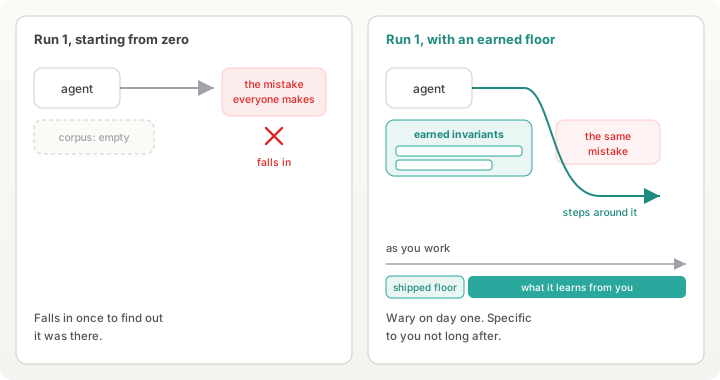
On day one the agent has done nothing for you, so it knows nothing about you. A learning system with an empty corpus is just a confident model with no scars. It hasn't been burned by the migration that needed a backfill before the cutover, or the endpoint that falls over the first time real traffic hits it, because as far as it's concerned none of that has happened yet. So it walks straight into the pit everyone walks into the first time, and you sit there thinking, this is the thing that's meant to be smart.
What people do to cover that gap is fill it in by hand. A page of onboarding rules, a pile of dos and don'ts stuffed into the system prompt, the same context pasted into every chat. And that sort of works, but it's you doing the agent's learning for it, and none of it compounds. You're not teaching something that remembers, you're maintaining a cheat sheet.
Most first-day mistakes aren't yours
The thing is, most of the mistakes that catch an agent on day one aren't special to you. The shape of "don't run the destructive step before you've checked the thing it depends on" holds whether you're touching a database, a billing system, or someone's calendar. The specifics change, the pitfall doesn't. So there's no good reason every new agent has to fall in once to find out it's there.
So our agents don't start empty. One arrives already carrying a set of hard-won invariants, the kind of caution you'd expect from something that has been around the block, before it has run a single one of your tasks. It's wary of the failure modes that catch everyone, on its first morning, without you writing any of it down.
We didn't write those rules, and that part matters to me. Hand-written best-practice lists age badly and they're usually platitudes, and an agent can smell a platitude as fast as you can. What it ships with instead was earned. We ran a lot of very different agents across very different work, let them get burned and actually learn, then kept only the part of each lesson that survives being stripped of anyone's particular tools or domain. What's left is the bit that holds anywhere. It reads as experience because it is experience, it just isn't yours yet.
Then it gets specific to you
The bit I care about more is what comes after day one. Those starting invariants are a floor, not a ceiling. They're deliberately general, which is what makes them safe to hand to everyone, and also what makes them a bit blunt. They keep the agent from doing something dumb on day one, they don't make it good at your particular job.
That happens on its own as it works. The moment the agent starts running your tasks, your own lessons start landing, and yours are sharper than the generic ones because they're about your actual constraints rather than everyone's. So they take over. The thing it was born knowing quietly steps back as the thing it learned from you moves to the front, and within not very long the agent's caution is mostly your caution, shaped by your work.
So the first run stops being the worst one. The agent shows up already knowing the mistakes everyone makes, and spends its time with you learning the ones only you make. That's the version of "it learns" I'm willing to put in front of someone on day one.