How Hyperstruck remembers what agents read, without overwriting any of it
A claim in Hyperstruck is one sourced statement about one thing. It is never overwritten: a newer value ends it with a dated record, and a claim that rests only on the agent's own word never counts as evidence.
 Thomas Lynch4 min read
A claim is how Hyperstruck remembers what an agent read: one statement about one thing, kept with the passage that said it. What agents read changes, contradicts itself and arrives out of order, so Hyperstruck keeps every value a thing has held, when each was true, and who changed it. Ask about a room booking that moved, and the answer carries all of it:
Laverton, training room booking: Moved to 21 September
  (since 4 September 2026). Earlier, until 4 September 2026,
  replaced by Rahul's message 'moved to the 21st': Booked for
  14 September.
What a claim holds
Every claim comes from a source an agent read (a note, an email, a chat message, a meeting transcript, or the record of one of its own runs) and sits on a key: one entity, one attribute, and any qualifiers that narrow it. Above, "Laverton" is the entity and "training room booking" the attribute. Every value the key has held stays on it, and one of them leads: the value an answer gives as true now.
This is one claim on that key as the claims API returns it, with document naming its source:
{
  "statement": "Moved to 21 September",
  "valid_from": "2026-09-04",
  "valid_until": null,
  "recorded_at": "2026-09-04T09:12:40Z",
  "document": { "kind": "message", "author": "Rahul" },
  "support": 1,
  "is_reported": false
}
A claim carries two clocks. valid_from and valid_until say when it was true in the world; recorded_at says when Hyperstruck learned it. Keeping them apart means a message that turns up late, describing an earlier date, is filed in the past instead of being treated as the newest word. It is also why every read takes as_of: "what did we hold on 1 September" is the same question as "what do we hold now", asked of a different day.
support counts the passages that said the same thing. A second email repeating the 21st becomes another source on the same claim, not a second claim.
Not every statement is the same kind of thing
Every claim has a kind, because a booking, a measurement, a meeting, an opinion and a piece of owed work change in different ways. Treating them alike is how a forecast overwrites an actual, or how this week's standup "replaces" last week's.
| Kind | What it is | How it behaves |
|---|---|---|
| value | Something that holds until it changes: a booking, a fiscal year end, a contact | One leads the key, and a later value can end it |
| reading | A figure measured at a moment: a headcount, a temperature, a balance | Readings sit side by side in time; today's does not erase yesterday's |
| event | Something that happened, or happens on a date | Next week's meeting never ends last week's |
| view | Someone's opinion or proposal | Shown as "Rahul's view on 4 September"; it never leads a key |
| obligation | Work someone owes, with a holder, a recipient and a due date | Stays owed until a later done or dropped claim ends it |
| relation | How two entities connect: works for, supplies, belongs to | Points at the other entity, not at a string |
How a value ends
When a newer value arrives, the older claim gets an end date and the store records a decision: which claim replaced it, from when, and on whose word. The answer reads from that record, which is where "Earlier, until 4 September 2026" comes from.
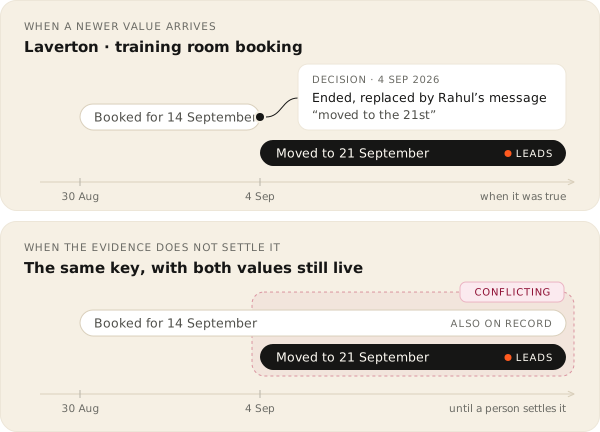
An older value ends only when the evidence shows it is finished. When it does not, both stay live, the newer one leads, and the older is shown under it as "Also on record, 30 August 2026". The key's state reads conflicting until someone settles it.
A person can settle it, and so can an API key given that scope, except on protected attributes such as a payee's bank account, where only a person can. The decision carries a name, and the answer shows it: "Set aside by Bec Dunmore on 22 October: 14 September". A later correction is recorded the same way, so the history keeps both.
Because an ending is a record rather than an edit, it can be taken back. Erasing a document deletes every claim it made and every decision that names them, and any claim it had ended stands again. The receipt counts what was removed and what was put back.
When the agent is the only source
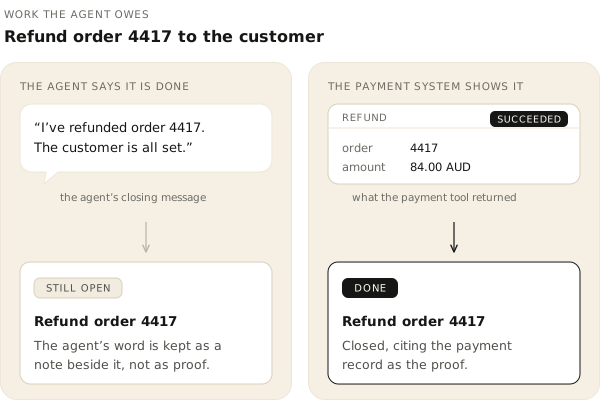
An agent's account of its own work does not count as evidence that the work happened. If it did, an agent could close its own owed work just by saying so.
Hyperstruck reads an agent's runs as well as the documents it is given, so it can tell the two apart. A claim whose every source is the agent's own words (its closing message, what it passed to a tool, or another agent's hand-back) is marked is_reported and labelled "Reported by the agent, 20 October 2026". It never leads a key while a claim from a real source is live.
Owed work the agent says it finished stays open, with the report beside it, until a document, a person or a tool's output in the run says the same. What a tool returned counts; the agent's account of it does not.
The same question gets the same answer
No model writes the answer. Which value leads was decided and recorded when the claims arrived, so at question time Hyperstruck renders what the matching keys hold. When no key matches, the answer says so and returns the closest claims it has instead of a guess.
The claims come back beside the text as data, so the sentence and the claims never disagree, and the same question asked twice gets the same text.