
Learning
How Hyperstruck turns finished work into reusable learnings that make every future run better.
In short
A learning is a lesson Hyperstruck has drawn from real work and proven over time, so your agents get better at the tasks they do repeatedly instead of starting fresh on every run.
Most agents handle the past in one of two broken ways. They forget everything between tasks and start every run from a blank prompt, or they remember everything indiscriminately and drown in their own history. Both fail for the same reason: the agent cannot tell which of its past experience should change what it does next.
Hyperstruck's learning system exists to make that judgment. It watches work happen, keeps the few learnings worth carrying forward, and brings them back automatically the next time they are relevant, so quality compounds run after run.
The learning system
Learning is automatic. It is not a mode you opt into or a quality you have to tune. When Hyperstruck runs the reasoning itself, a learning drawn early in a task can improve the rest of that same task; when it sits underneath another framework purely as a learning layer, each finished run makes the next one better. Either way, you do not have to manage it.
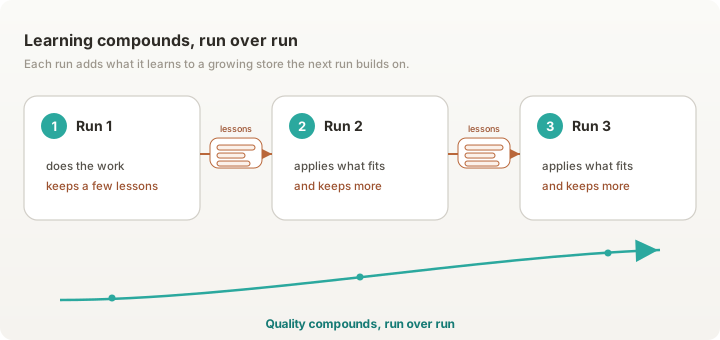
Learnings come from two places, and the second is easy to miss. Most are distilled from what a run actually did: the tool that failed, the order that turned out to matter, the check that should have come first. But people also just say how they want things done, in passing, in the middle of a request. We always cc the account manager on anything going to a client. That is a standard, stated once, and an agent that only mines execution traces would never pick it up, because nothing in the trace demonstrates it. Hyperstruck learns both.
Not everything an agent does becomes a learning, and that is the point. Hyperstruck keeps only learnings that are grounded in what actually happened, that could help in a different situation rather than just restating this one, and that are free of secrets or personal data. When a new learning matches one already on file, it strengthens that learning instead of adding a near-duplicate. The result is a small, trustworthy body of knowledge rather than a growing pile of noise.
What a learning is
A learning is a short, conditional rule: when this kind of situation comes up, do (or avoid) this.
When a customer signals they might switch providers, raise a retention offer before responding.
When an application is missing a required document, request it before declining the application.
When one person has dominated a meeting, invite the quieter participants in before it ends.
When a refund has already been issued, do not issue it a second time.
When an appointment is canceled at short notice, offer the slot to someone on the waitlist before leaving it empty.
That is the whole shape of it, whatever the work: a specific, legible learning an agent can act on, not a document to read or a log to search.
What makes it more than a note is that it earns its place. A learning that keeps proving useful is applied more readily; one that starts misleading is pulled back; one that nothing reconfirms fades over time. A learning builds authority by working across many separate runs, so a single lucky or unlucky outcome never decides its fate. And a learning only surfaces when it genuinely fits the task in front of the agent, not merely because it shares a topic, so your agent is never nudged by learnings that look related but are not.
What learnings are
Taken together, the learnings an agent accumulates behave less like a filing cabinet and more like judgment that sharpens with experience.
Weighed, not filed
Learnings are not sorted into rigid categories. The same learning can act as a firm guardrail in one task and a gentle hint in another, depending on how well it has proven out and how relevant it is right now.
They mature
A learning that has repeatedly proven itself becomes part of how the agent works by default, so it no longer needs spelling out. If it starts to fail, it loses that standing just as readily.
They widen to fit
A learning first learned about one case does not stay stuck there. As evidence arrives from genuinely different cases, it broadens to the class it really covers, rather than being generalized on a hunch after a single example.
Shared only when safe
A learning stays with the agent that formed it until it has proven itself repeatedly, and even then only the generalized rule crosses, never the cases behind it. Where it lands is the agent's space, not the whole organization.
Open to correction
New evidence can update or qualify a learning instead of being ignored. A learning that works everywhere except one situation records that exception, so it keeps helping where it fits and stays quiet where it does not.
They repair themselves
When a learning leaned on a claim that later turns out to be wrong, the learning is revisited rather than left standing on evidence that no longer holds.
Hyperstruck can also ship with a curated starter set of learnings, so a brand-new deployment is not starting completely cold. As an agent builds up its own experience, that starter knowledge naturally gives way to learnings earned on your actual work.
When the world moves
A learning can stop being right without anyone contradicting it. The policy changes, the limit is raised, the integration is replaced, and a learning that was hard-won last quarter quietly becomes wrong.
Hyperstruck treats this as different from a learning being disproved, because it is. When a claim a learning depends on is superseded, the learning is not silently deleted; the agent stops treating it as settled, and where the stale value is written into the learning's own wording, it is routed to a person to reconcile rather than suppressed on a machine's say-so. Where the dependency is precise enough to check, the agent is told the claim contradicts the learning and decides with both in view. What never happens is a claim talking an agent out of a safeguard: a learning protecting something destructive or externally visible cannot be defeated by anything the agent has come to believe.
What they are not
The sharpest way to understand a learning is by what it deliberately is not.
- Not the record of the run. A learning is a distilled, conditional rule, not a transcript. Hyperstruck does keep a governed record of each finished run, but it is a separate shelf with its own privacy and erasure policy, and the agent does not reason by replaying it. See Episodes.
- Not a fact about one customer. Anything true of one named company, system, or person belongs on the claims shelf. Storing it as a learning would either poison the learning or strip the very specificity that made it useful.
- Not document retrieval. A learning is not a passage pulled up because its words resemble your goal. It surfaces because it genuinely fits the situation, not because it shares keywords.
- Not a one-run impression. Something an agent sees once, even several times within a single task, is not yet a learning. Knowledge has to prove out across separate runs before it is trusted, which stops an agent from convincing itself of a pattern it really only saw once.
- Not a fixed label. Nothing decided up front locks a learning in as a warning or a tip forever. Its weight is judged in context, every time it comes up.
- Not a hunch that hardens on sight. A learning seen once is a suggestion to weigh, never a command to obey. It earns authority by proving useful, not by being repeated.
- Not verified because nothing objected. A learning nobody checked is reported as unchecked. Silence is not endorsement, and a learning cannot inherit confidence it never earned.
- Not permanent truth. A learning loses standing when nothing reconfirms it, when later evidence contradicts it, or when it leads the agent astray. Letting the wrong learnings fade is part of the design, not a flaw in it.
- Not a place secrets live. Credentials and personal data are stripped out before anything is stored, and learnings that touch sensitive ground are never shared between agents. A distilled learning does not keep the original wording of the request either: what survives is a scrubbed cue, so it cannot carry someone's raw prompt into a future run. Sharing and visibility sets out the scrubbing in full, and what has to be true before a learning reaches another agent.
Where this fits
Reasoning is how Hyperstruck makes good decisions in the moment. Learning is how it makes better decisions next time. To work with learnings directly, to store, search, retrieve, and reinforce them, see the Learnings API. To wrap an agent you already run, see the learning loop. To see how learnings shape a live run, see Reasoning. To see exactly when a learning may reach another agent and what crosses with it, see Sharing and visibility.