
Memory
The three things a Hyperstruck agent keeps from a finished run, and why they are kept apart.
In short
A finished run leaves behind three different things: learnings about what to do, claims about what is true, and a record of the run itself. Hyperstruck keeps them on separate shelves, because each one answers a question the other two would answer badly.
Most agent products offer one memory. Everything the agent encounters goes into a single store, and everything comes back out of it by resemblance. That design fails in a specific, predictable way: a learning worth carrying to every future task and a detail true only of one customer end up competing for the same slot, judged by the same test, and surfaced by the same search.
They should not be. Always confirm the shipping address before a large order is worth remembering forever and applying everywhere. Ashgrove Freight ships out of the Altona depot is worth remembering precisely and applying nowhere else. Blur them together and you get the worst of both: learnings polluted with specifics that make them wrong elsewhere, and claims diluted into generalities that make them useless here.
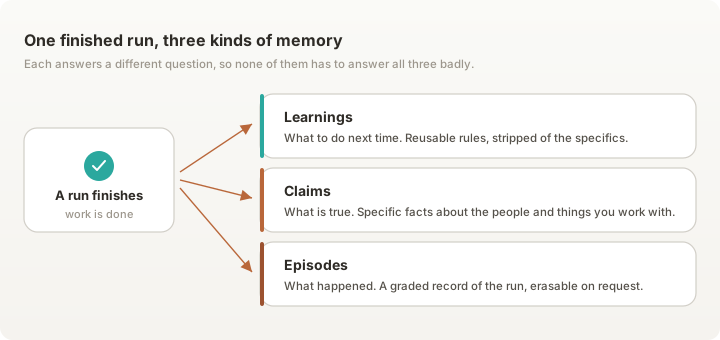
The three shelves
Learnings
What to do next time. Short, conditional rules earned across many runs, deliberately stripped of the specifics so they transfer.
Claims
What is true. Precise, sourced facts about the entities your agent works with, versioned so the past stays answerable.
Episodes
What happened. A graded, privately scoped record of each finished run, erasable on request, though no public endpoint exists yet.
Why the separation is the feature
The split is not filing tidiness. It is what lets each shelf apply a standard the others could not survive.
| Learnings | Claims | Episodes | |
|---|---|---|---|
| Answers | What should I do? | What do I know? | What did I do? |
| Earns trust by | Proving out across many separate runs | Being independently corroborated, and by who said it | Nothing; it is a record, not a belief |
| Holds specifics? | No, they are removed | Yes, that is the point | Yes, in full |
| Ages by | Losing standing when nothing reconfirms it | Growing stale until re-observed | Simply getting older |
| Shared beyond one agent? | Only when general, proven, and clean | Never. An agent sees only its own claims; a curator sees across agents | Never |
The clearest consequence is a privacy one. Because learnings are supposed to travel, everything identifying is scrubbed out of them before they are stored. Because claims are made of exactly that identifying material, they cannot be protected by scrubbing, so they are protected by boundaries instead: private by default, fenced by the database itself rather than by application code, and erasable per entity. One policy could not have covered both. Two shelves means neither has to compromise.
Where they meet
The shelves stay separate in storage and meet in one place: when the agent plans.
A learning that says when the account tier is enterprise, run a compliance review is inert until something establishes the tier. A claim that says Ashgrove Freight's tier is enterprise is what makes it fire. The same claim, saying SMB, is what tells the planner the learning probably does not apply here. Claims do not rewrite learnings and learnings do not absorb claims; the planner sees both and decides, which is why a claim can also never talk an agent out of a safeguard.
Related pages
- Reasoning for how a plan is made in the first place
- Learnings API and Claims API for working with either shelf directly
- Security and data isolation for how each shelf is fenced