
Your best people's judgment, in every answer
New: Workflows bring what your whole company knows into the agents and tools your team already uses. Composer builds them from one sentence, and Evals train a model on your senior people's corrections.
Hyperstruck remembers what your whole team knows: the notes from every conversation, what each client asked for, and how your senior people make decisions. Until now your team got that through Hyperstruck. Now they get it inside the agents and tools they already use. No new app to learn.
That is Workflows. An expert describes a decision once. Hyperstruck builds it from what the company already has. Everyone else asks for it in their own words, from their own tools, and gets the same answer your best people would give.
Find the right candidates in seconds
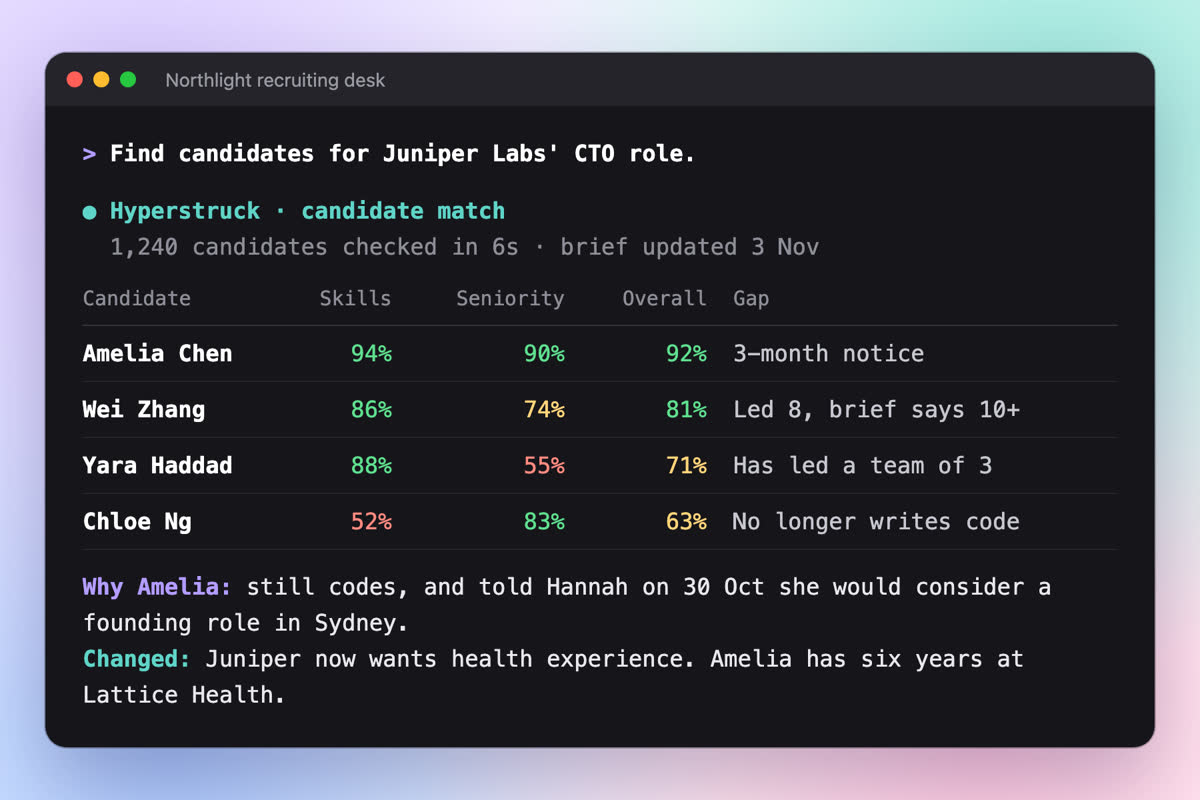
A recruiter asks her agent: "Find candidates for Juniper Labs' CTO role." She does not paste the job details. Hyperstruck checks 1,240 candidates in six seconds and returns each one scored on skills, seniority and overall fit, with the gap that could stop the placement.
The list already takes into account:
- What was said on both sides. Notes from every chat with candidates and with the client, saved automatically.
- What the client wants now. Juniper asked for health experience last week. The list changed that day.
- How your senior recruiters decide. Your top recruiter knows this client wants a hands-on leader, not a big-team manager. Every search uses that.
- What other recruiters learned. Another team found Juniper only hires people who still write code.
Example: Amelia Chen tops the list at 92%. She still writes code, told a colleague last week she would consider a founding role in Sydney, and has six years in health. Her one gap is three months' notice.
Describe the decision once. Hyperstruck builds the workflow.
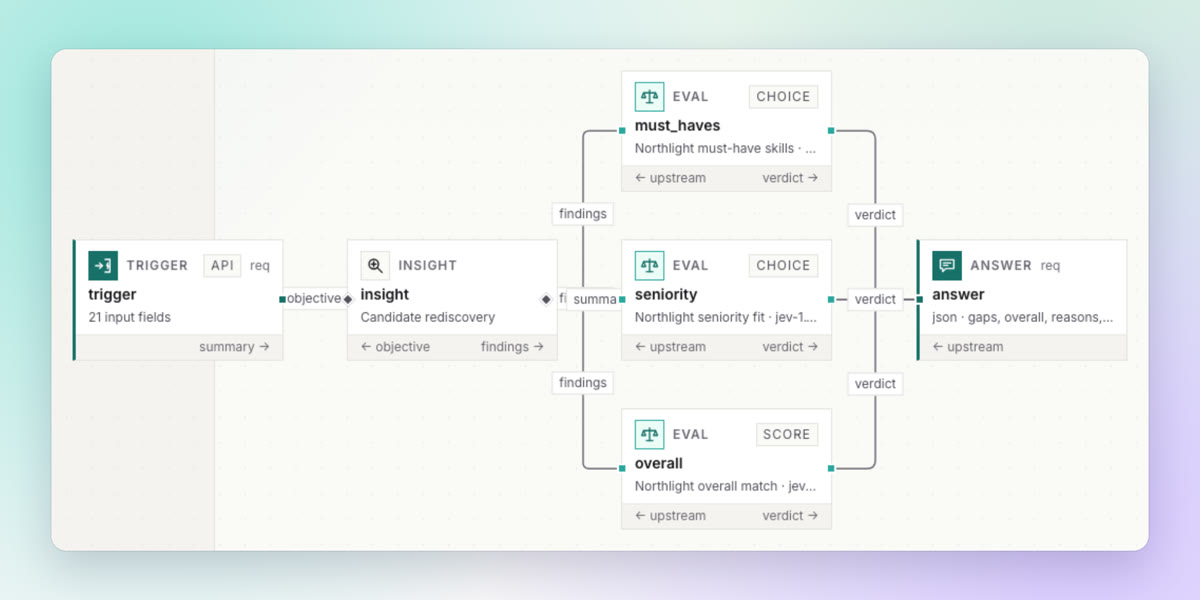
- Say what good looks like. "Match a CV to the client's brief." Composer looks at what your company already has, its knowledge, Insights and Evals, and puts the workflow together.
- Your team uses it where they already work. They ask from the agents and tools they already use. Hyperstruck finds the right workflow for the task.
- Every answer is judged the same way. Skills, seniority and overall fit, with reasons and gaps a person can check. Every run is on record, and anyone can correct a verdict.
Workflows suit work that repeats: first-line support, triage, candidate matching. Read the Workflows docs.
Evals: train a model on your best people's corrections

Your senior people fix the answers they disagree with. Hyperstruck fine-tunes a model on those fixes, so your best people's judgment is applied to every run, not only the ones they see.
- Trained on real runs. Every workflow run, and every fix your senior people make, becomes training data. No test set to build by hand.
- Old and new, side by side. Compare the new model with the current one on the same runs, and see at a glance which agrees with your senior people more often.
- Swapped in with one click. Put the new model into a live workflow with one click. Your team keeps asking the same way.
Example: a candidate who managed 140 people kept being marked too senior. Your top recruiter corrected it: the client wants someone who still writes code, and she does. The trained model now gets this right for every recruiter.
When the client's salary band changes, you update the brief. No retraining. You retrain only when the way your team judges changes. Teams that need it can run training inside their own Kubernetes cluster. Read the Evals docs.
For forward deployed engineers: set up a customer once, deliver in their tools

Load a customer's documents and describe the decision they need. Composer builds the workflow from what is there, with Insights to find what is true now and Evals to judge the answer. The customer's staff use it from your agents, whatever framework you build with, through Hyperstruck's MCP server. You deliver the use case in a fraction of the time.
Example: an engineer loads an insurer's claim files and asks for "sort new claims by urgency, and send repeat claims to a person." The insurer's team runs it from their agents the same week.
Also new
- Insights flags a finding when the facts behind it change. If a customer's plan or a contract date changes after a finding was raised, the finding says so and holds its draft message until someone checks it.
- Insights does not repeat itself. A finding a rule has already raised is not raised again, so each list holds only new work.
- Insights runs inside a workflow. A support triage can look up this customer's past outages before it decides how urgent a ticket is.
- Documents outrank an agent's say-so. A fact from a signed contract or a statement wins over a fact an agent only reported. Example: an agent notes a customer is on net-30, but the signed contract says net-60. Collections uses net-60.
- A document can close a fact. When a letter says an account is no longer on hold, the hold ends, with the letter as the source.
- Owed work closes with proof. Agents record who owes what to whom. Example: when a statement shows an invoice is paid, the agent closes the payment it was chasing and cites that statement.
- Search what is true. Agents and people can search facts by meaning and date, including commitments still due.
- Dates stay in the right time zone. A due date written in Sydney stays that Sydney date everywhere it is read.
- Every agent has a Claims tab. See every fact an agent knows, each with its source.
- Long and scanned PDFs are read in full. Every readable page of a large PDF is used, and scanned pages on watched sites are read too. Watched PDFs keep their original file and title.
- See the value each agent delivers. Each agent's page shows the value it has delivered over its life, and agents can record value as they work.
See it on your own work
Tell us one decision your senior people make every day. Write hello@hyperstruck.com and we will show you the workflow.