

Agents Can Now Start With Experience
Hyperstruck agents no longer need to learn every basic lesson from your team the slow way. They can start with proven SDLC and security experience on day one.
The last generation of agents started cold. They could read your prompt, inspect your repo, and produce a plausible answer, but they still needed your team to keep injecting the lessons that experienced people already know: where production systems fail, which security checks are non-negotiable, how a framework should be used, and what belongs in review before a customer ever sees it. Hyperstruck agents can now start with that experience already loaded.
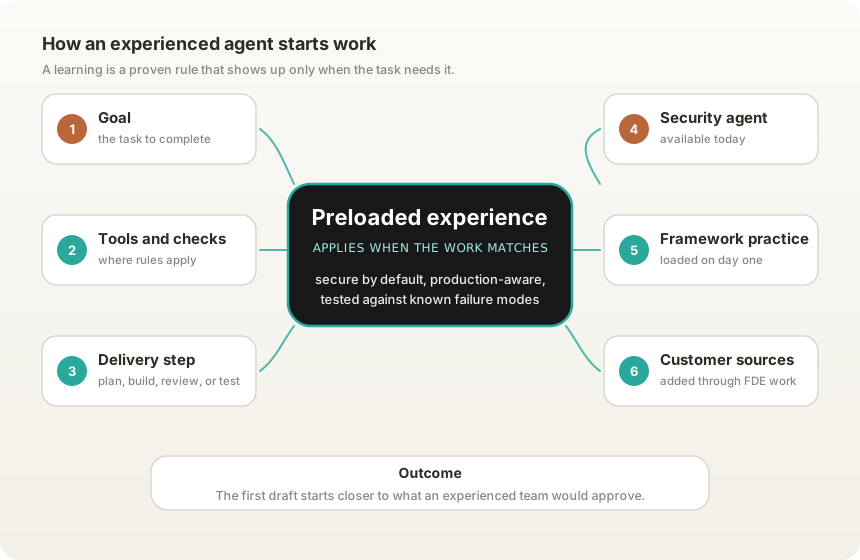
That changes the business case for agentic work. The question is no longer how long it takes before an agent stops making beginner mistakes. The starting point moves higher. Software teams get agents that already know useful delivery patterns. Security teams can use a web security agent that already carries established risk categories and reference codes. Platform teams can package experience for their own customers instead of handing them an empty agent and asking them to build the expertise from scratch.
Not The Same As Innate Intelligence
Hyperstruck agents already ship with innate intelligence: generic caution earned across many kinds of work, the failure modes everyone hits before an agent learns your specific constraints. That is a floor, not a ceiling. It is deliberately broad, and it stops the obvious day-one mistakes without pretending to know your stack.
What this post describes is different. Cloneable agents arrive with domain experience already loaded: web security patterns with OWASP and CWE references, SDLC delivery discipline for framework work, specialist rules for a class of problems rather than every problem. Innate intelligence is the safety net every agent gets. Preloaded domain agents are the specialist head start you can deploy, clone, and offer to customers who should not have to rebuild that expertise themselves.
Day One Is No Longer Blank
Most teams do not suffer because agents lack raw capability. They suffer because the agents lack judgment at the moment work begins.
A developer asks for a new API endpoint, and the agent writes one. Then the human adds the missing authorization check, the request validation, the pagination limit, the failure-path tests, the audit trail, the framework convention the repo follows, and the production constraint everyone on the team knows but nobody put in the prompt.
That re-teaching loop is expensive. It slows senior engineers down, gives junior developers a false sense of confidence, and turns agent adoption into a supervision burden. Hyperstruck's new cloneable agents compress the ramp. A web Python framework agent can now start with experience around common web patterns, routing, validation, testing, error handling, and production-ready implementation shape. A team using agents for SDLC work starts closer to useful output before their own history has had time to accumulate.
The value is not that every customer gets the same frozen checklist. The value is that every customer starts from a stronger baseline, then the agent keeps adapting as it proves what matters in their environment.
Experience Shows Up In The Work
Take a normal software task: build a password reset flow in a Python web app.
A cold agent can generate routes, templates, and emails. An experienced one starts with the parts that usually decide whether the feature is shippable: single-use tokens, expiry windows, rate limits, account enumeration protection, email delivery failure handling, tests for invalid and reused tokens, and framework-appropriate integration points.
For a junior developer, that is the difference between receiving a pile of code and receiving a guided first draft that carries production expectations into the implementation. They still learn. They still review. They still own the change. But the agent starts from patterns they might not have known to ask for.
For a senior developer, the benefit is quieter review. The comment they would normally leave for the tenth time is already present in the plan or the code. Their time shifts from catching basics to making better product and architecture calls.
Security Agents Start With A Real Baseline
Security work makes the cold-start problem more obvious. A generic agent can say "validate inputs" or "follow OWASP." That is not enough.
The Hyperstruck web security agent is the clearest example available today. It starts with experience across categories of web risk, OWASP Top 10 reference codes, CWE reference codes, and concrete security lessons that apply to implementation and review. For example, when SAML is in scope, the agent does not stop at "check the signature." It knows to care about issuer, audience, destination, response binding, and malformed assertions. When link handling is in scope, it knows opener isolation matters. When reverse proxies are involved, it knows which headers deserve suspicion unless the trusted proxy set is explicit.
That matters commercially because security expertise is scarce. Not every company can hire every specialist before they adopt agents. With Hyperstruck, a customer can start this security agent from a richer baseline immediately, then let the agent's experience sharpen around the customer's own systems, controls, and review patterns.
Cloneable Agents Turn Expertise Into An Offering
This is not only useful for internal engineering teams. Hyperstruck customers can package agents with experience for their own end customers.
A company delivering agentic SDLC to software teams can offer a web framework agent that arrives with delivery discipline already loaded. A security provider can offer a review agent that starts with domain-specific risk awareness. A platform company can give every new customer an agent that reflects the practices they want adopted from day one.
The packaged web security agent is available now. For other domains, we can work with customers based on demand, or bring their own internal data sources into the agent's experience through our Forward Deployed Engineer services.
That creates a new kind of product surface: expertise that ships with the agent. The customer does not begin with an empty shell. They begin with a working baseline, then the agent keeps becoming more specific to their environment as it is used.
The Outcome
The practical result is faster time to value with less manual context.
Teams spend less time telling agents obvious things. Junior developers get stronger first drafts and clearer examples of what good looks like. Senior engineers review fewer preventable mistakes. Security teams can apply specialist knowledge earlier in the workflow. Product and platform companies can deliver agents that feel useful on day one to their own customers.
Agents starting with experience is more than a better first prompt. It changes the shape of adoption. The agent does not need months of your team's mistakes before it becomes useful. It can start with the lessons that matter, then make them yours through use.